Our collaboration with Manchester Museum coincided with the renovation of their Oxford Road site, and has been fantastic opportunity to explore both their archives and their culture. As part of the recent renovations the museum has restated its commitments to sustainability, biodiversity, and inclusivity, and so their work is as much about using their reputation and resources to nourish the future of the city outside its doors, and the wider natural world beyond that, as it does about the history and the past.
Taking the opportunity to fully dispel any of the old fashioned stereotypes that can follow other museums, Manchester Museum is dedicated to sustainability, biodiversity, and inclusivity – something we’ve been able to depict in detail throughout the new illustrations, from the self-examination of our A for Archaeology tile to the Vivarium helping to preserve living species in R for Rainforests.
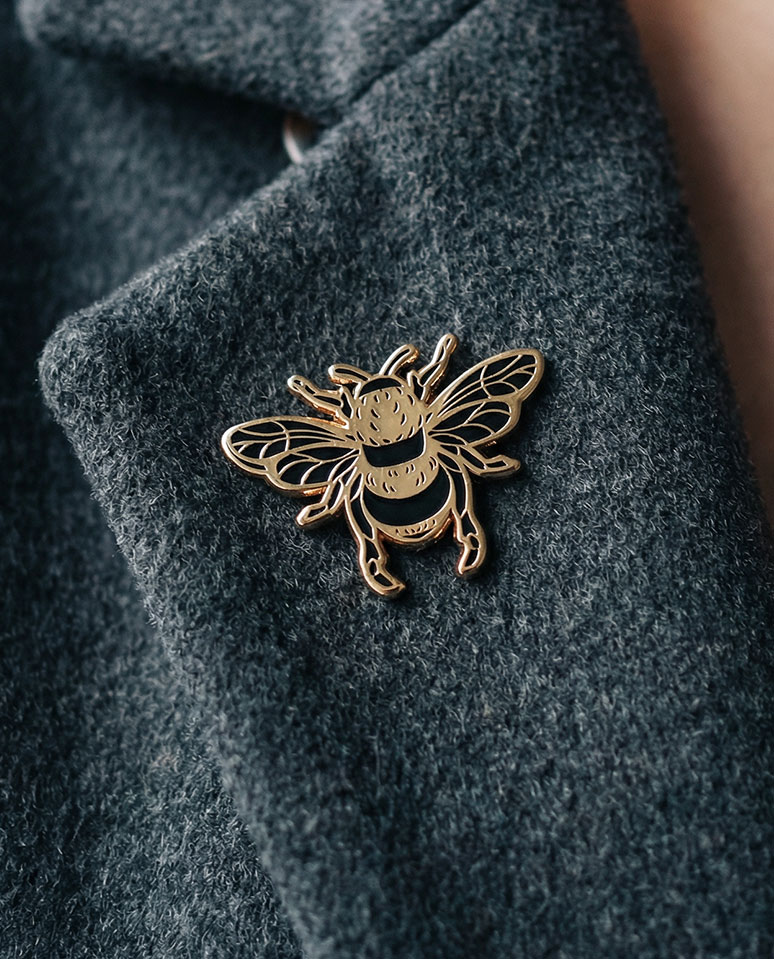
Two new complete MANCHESTER letter series have been created in dialogue with the Museum, along with an illustrated history of the bee in art and culture.
“This collaboration with The Sculpts has been a pleasure to watch unfold, and a beautiful encapsulation of everything we’ve focused on during the recent transformation at Manchester Museum.”
Esme Ward, Director, Manchester Museum
M – Manchester Museum
This M tile is the opener in our new series created in close collaboration with Manchester Museum. Museums are dogged by stereotypes, but Manchester Museum has worked hard to challenge them all – and it’s this modernity and progressive thinking, fused with a commitment to protect and understand the past, that we’ve sought to capture in this tile.
The themes are all inspired by Manchester Museum’s own priorities: sustainability, biodiversity, and inclusivity. With the brand building and its newly renovated entrance as a backdrop, we’ve rendered a thriving habitat around it, from bats and other wildlife and fauna to cyclists, pedestrians and dog walkers. It’s a vision of the Museum’s future, integrated into the wider community and contributing to the solutions and dialogues that our city and our country need.
A – Archaeology
Archaeology is a major aspect of Manchester Museum’s heritage, and our A tile celebrates the wealth of extraordinary exhibits that can be found there, whilst also acknowledging the ongoing issues of ownership that surround all museums in the 21st Century. With so many exhibits acquired at a time when Britain’s relationship with the world was very, (*ahem*) different, it’s important that they are handled with sensitivity to the cultures and periods in which they come from.
As such we’ve drawn on a wide range of exemplary objects, ranging from the prehistoric to the Roman, Medieval and 20th Century. Many of the objects were excavated locally, including the Manchester Word Square, from the Roman fort at Castlefield, thought to be among the earliest evidence of Christianity in Britain. From further afield, a Corinthian helmet brings to life the battlefields of the ancient Greeks. Archaeological objects can inspire empathy and foster an appreciation of diverse cultures and our shared humanity, as well as shedding a new light on modern challenges.
In our illustration the A is supported by classical pillars, while sitting behind everything is a sheet outlining a map of Greater Manchester, with scribbled notes outlining each subject and how it is studied. The result is a snapshot of the treasures anyone can now view in the heart of the city.
N – Nature’s Library
N is for Nature’s Library, or to give it its full name the ‘Living Worlds and Nature’s Library gallery’ at Manchester Museum. For this tile we’ve attempted to capture the ‘cabinet of curiosities’ theme which is itself an analogy for museums. While the idea of a ‘cabinet of curiosities’ has long been an enchanting Victorian trope and giving birth to all kinds of mysterious narratives, it belies an uncomfortable truth about all museums. When wealthy benefactors display their ‘finds’ from around the world behind glass, who gets to define what is curious as opposed to normal? What is the double-edged cost of ‘curiosity’ to nature and our fellow humans?
Framing the curious creatures – including the skeleton of a sperm whale which has watched over museum visitors for 125 years – is the original internal architecture designed by Alfred Waterhouse, including the iconic staircase, which remains today. We hope that this tile, like the Nature’s Library itself, can help inspire a deeper appreciation and connection with nature.
C – Chinese Culture Gallery
Chinese immigrants have been part of Manchester culture since the start of the 20th century, choosing to settle around what is now China Town as an alternative to Liverpool. The Lee Kai Hung Chinese Culture Gallery in Manchester Museum tells this story and more, drawing from historical and contemporary links between China and Manchester, as well as offering a wide variety of Chinese perspectives. From migration to friendships and collaboration, it is a treasure trove of imagery for the illustrator, with fine porcelains, exquisitely carved jades, and ancient bronzes on display. We chose to focus our C tile around the great mythical beast of Chinese culture – the dragon. In China the dragon represents, among other things, good luck, strength and health. Here it is flying – talons and teeth bared – around the letter C, and adorned behind with cabinets and exhibits from the gallery itself.
H – Herbarium
For H we have chosen the Herbarium, Manchester Museum’s botanical storeroom. The Museum’s botanical expertise goes back to 1860, both in terms of recording knowledge and sharing it. In 1892 Frederick Wiess, the University of Manchester’s second ever Professor of Botany, was so impressed with the Museum’s models used for group teaching he described them as a ‘lesson in themselves’.
Today Manchester Museum’s Herbarium team welcome botanists specialising in everything from flowering plants to ferns, seaweeds, lichens, fungi, and algae to study its preserved specimens. The number on offer has grown to 750,000 over the centuries, thanks to important donations from benefactors who cared deeply about the natural world, including Charles Bailey, James Cosmo Melvill, and Leopold Hartley Grindon.
We’ve made sure the H in this tile is making itself at home there, rooting itself into the ground, whilst surrounded by bell jars full of valuable, exotic plant sculptures and homegrown gems like the Altringham carrot and Timperley rhubarb. Each of these tiles is hand-rolled in the UK’s ceramic heartland Stoke-on-Trent, and designed and fired in Manchester.
E – Elephant Mahārājah
Mahārājah the elephant had a long journey from India to Manchester, though by all accounts it was the British leg that proved the most colourful. Over 150 years ago, he was purchased from a travelling circus in Edinburgh by the owner of the Belle Vue Zoo in Gorton. Legend has it that Mahārājah was too heavy for the train – his carriage ended up well and truly demolished. So the elephant keeper, Lorenzo Lawrence, walked him the entire 200 miles, a journey which took 10 days.
Mahārājah’s massive skeleton remains on display at Manchester Museum, so apart from the occasional trip to Piccadilly Station – for old time’s sake, presumably – he’s not going anywhere. We’ve rendered him inside and out with his former homes above, and below is the train that couldn’t contain him. The tile is ornamented with exotic and native plants and birds – as well as the occasional Indian flourish – to celebrate the two cultures coming together. The hint of a map in the background also helps to evoke a sense of travel and discovery.
S – South Asia Gallery
We’re big fans and proponents of the amazing and unexpected results created through collaboration, and the South Asia Gallery at Manchester Museum is an example of this process at its very best.
30 curators came together to share the contribution and experiences of the diaspora community, and we’ve tried to capture as much of what they did as possible in our S tile. Objects from the gallery, and images of the dynamic performance space, have been placed around the letter S, drawing on all kinds of touchpoints, from transport and science to religion and political icons. We’ve framed it all in a delicate pattern inspired by typical South Asian designs, and is captioned in English and eight regional languages – Gujarati, Hindi, Urdu, Bangla, Punjabi, and Tamil.
T – T. rex
T is for T. rex, also known as Tyrannosaurus – and in this case, Stan. A popular character at Manchester Museum, he’s actually a cast from an original found in South Dakota, USA, but that is the last thing on your mind as you stand under his massive 12m frame. Stan’s in full predatory pose in our tile, peering out from behind the T, and surrounded by a tapestry of speculative prehistoric life that help to bridge the Millenia. These include some equally gigantic ammonite fossils, and the 300 million-year-old Sigillaria fossil tree. One of the largest ancient tree fossils in the world, it has been proudly displayed in Manchester Museum since the late 1880s.
E – Egypt and Sudan
Our other E has to be for Egypt, or more specifically Manchester Museum’s world-famous Egypt and Sudan gallery. This spectacular collection tells the story of the lives and afterlives of people who lived on the Nile two Millenia ago, as well as the stories of how these artefacts were found and moved in the colonial 19th century landscape.
We’ve made the E into a sarcophagus, complete with linen binding, its ornate lid engraved with hieroglyphics and deities. A plethora of other Egyptian images from the exhibits are utilised, from the pyramids to columns serpents, and pharaohs – and most importantly a special connection with Manchester.
In Egyptian culture the honey bee was formed from the tears of the sun god Ra, making them givers of life – liquid gold. They were also the only creature able to travel between here and the underworld, communicating between the two realms. Given that bees are so important to us and our fellow Mancunians, we had to make sure a hieroglyph bee was on there somewhere. (If you can’t spot it, it’s undertaking its epic journey down at the bottom, next to our logo.)
R – Rainforest
Conservation is at the heart of Manchester Museum’s objectives, and nowhere warrants protection more than the world’s rainforests. The Vivarium at Manchester Museum is home to a diverse collection of live amphibians and reptiles, including many critically endangered species native to Panama and Costa Rica. It’s rare for museums to look after live animals – normally if an animal is inside a museum’s glass case it will be airless and motionless – but Manchester Museum has been doing it for over five decades. You’ll find all kinds of species in their care, and quite a few of them camouflaged around our illustration here, including the Harlequin Toad and the tiny Poison Dart Frog.
The R tile blends the natural rainforest and vivarium together, and a map at the top left tells the story of their journey from the rainforest to Manchester.